
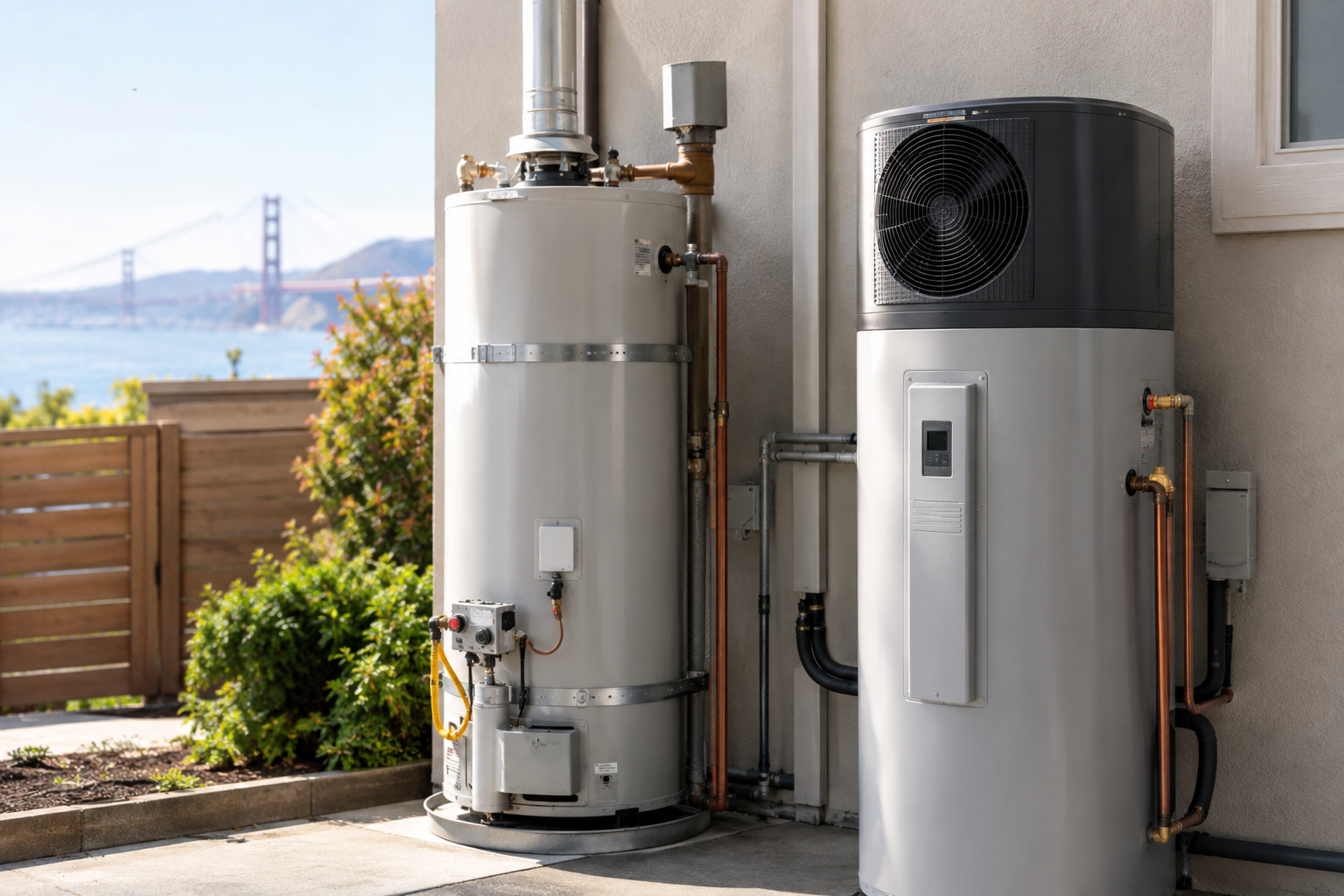
What the Bay Area Gas Water Heater Ban Means for Property Owners
Traditionally, when a water heater fails, it creates inconvenience for a landlord, but the replacement is relatively straightforward. However, replacing a gas water heater could become more complicated in the near future.
If you’re a property owner or landlord in the Bay Area, you’ve likely heard about the upcoming changes to the Bay Area Air Quality Management District’s (BAAQMD) Rule 9-6, which establishes new emissions requirements that will affect the replacement of certain gas water heaters.
Known as the Bay Area gas water heater ban, there is a lot of confusion about what BAAQMD Rule 9-6 actually means for property owners. Are gas water heaters being banned outright? Will I have to make expensive modifications to my property?
These are understandable questions. This article will explain what BAAQMD Rule 9-6 means for property owners and landlords and what they can do to prepare before an aging water heater creates an unexpected complication.
What is BAAQMD Rule 9-6?
Officially titled Nitrogen Oxides Emissions from Natural Gas-Fired Boilers and Water Heaters, BAAQMD Rule 9-6 is the Air District’s new rule aimed at regulating NOx emissions from gas-fired water heaters.
While the goal of the new Bay Area water heater regulations is to eventually establish a zero-NOx emissions standard, it doesn’t mean landlords will need to replace their gas heaters overnight.
Rather than requiring the removal of functioning gas water heaters, the new requirements apply when an existing gas water heater reaches the end of its service life and needs replacement.
What that means is that, instead of simply replacing the old gas-powered hot water heater with another gas water heater, a potentially more complicated replacement may be necessary.
At its core, BAAQMD Rule 9-6 is really an emissions standard. The Air District considers nitrogen oxides (NOx) pollutants from combustion, and Rule 9-6 essentially requires that all replacement hot water heaters meet a zero-NOx emissions standard.
While the law doesn’t explicitly require heat pumps, in practice, electric heat-pump water heaters are currently the only technology available that can meet a zero-NOx emissions standard.
There are electric tankless water heaters, but they draw a vast amount of electrical power and are largely impractical for meeting hot water needs without a major power upgrade.
Should a different technology eventually become available that meets the standard, it could theoretically be used instead. But in many cases, an electric heat pump will be the de facto replacement choice.
At this time, BAAQMD Rule 9-6 is only applicable to natural gas water heaters. The rule does not apply to gas stoves, ovens, or dryers.
Rule 9-6 is also only applicable to areas within the Bay Area Air District’s jurisdiction, not the entire state of California. That jurisdiction includes:
- Alameda County
- Contra Costa County
- Marin County
- San Francisco County
- San Mateo County
- Santa Clara County
- Southwestern Solano County
- Southern Sonoma County
When Does the Bay Area Gas Water Heater Ban Go Into Effect?
In March of 2023, the BAAQMD officially adopted the zero-NOx, gas water heater ban as an amendment to Rule 9-6.
Currently, the ban is set to take effect on January 1, 2027, for water heaters with capacities under 75,000 BTU/hr. Water heaters of that size are typically used in residential homes. The zero-NOx requirement for water heaters sized 75,000–2,000,000 BTU/hr isn’t expected to take effect until January 1, 2031.
However, the Air District has proposed amendments that could push the deadline for smaller water heaters back further until January 1, 2028. That proposed change will be discussed by the Air District board in November 2026.
Regardless of any change to the deadline, property owners and landlords should understand that they won’t necessarily need to take immediate action.
Under the law, existing equipment can continue operating just as it always has. It is strictly a replacement that will trigger the requirement. Neither will the sale of a property trigger replacement. If your current gas water heater continues to work for the next few years, no action would be necessary until it ultimately fails.
What the New Bay Area Water Heater Regulations Mean for Landlords and Property Owners
Because a failed water heater can no longer be replaced with a like-for-like traditional gas unit, property owners and landlords could face challenges in certain situations installing a heat pump replacement.
Heat pumps use electricity to heat water. Depending on the specific situation in the home, installing a heat pump could require greater electrical capacity, new wiring, and additional breaker space.
Heat pumps require condensate drainage and additional space and airflow than the previous gas-powered water heater. That can result in additional plumbing modifications and gas line work, which will require permits.
For owners of older properties, these challenges may be more significant. If a gas water heater fails in a rental property, it may require an emergency replacement for the tenants.
How much these repairs would cost depends on the home’s current electrical capacity and the need for modifications. Because the potential replacement cost can vary, property owners should evaluate it sooner rather than later, before equipment fails and creates an unpredictable expense.
Proposed Bay Area Gas Water Heater Ban Exemptions
With the Bay Area natural gas water heater ban tentatively set to begin on January 1, 2027, property owners are naturally wondering whether there are any exceptions to the rule.
In July 2026, the Air District released several proposed amendments that could provide some property owners with flexibility in situations involving affordability, electrical limitations, or physical space constraints. The Board of Directors is scheduled to meet in November 2026 to consider these amendments and adopt the rule’s final language.
One exemption being considered involves significant electrical limitations. Many older properties in the Bay Area have insufficient electrical capacity, which would require extensive rewiring to install an electric heat pump. These properties could potentially qualify for an exemption.
Other properties without adequate physical space or ventilation to accommodate an electric heat pump water heater are also being considered for an exemption.
There are also income-based exemptions being considered. Low-income property owners may qualify for an exemption based on specific income or housing cost criteria.
The Air District is also considering additional flexibility, including delayed compliance in other situations involving small water heaters, hydronic systems, and emergency replacements.
Because these exemptions have not yet been formally adopted, property owners and landlords should not assume their property will qualify for an exemption until the final language of Rule 9-6 is adopted and the eligibility criteria are clear.
What Property Owners Can Do Now, Before the 2027 Gas Water Heater Ban Takes Effect
Whether you own a single-income property, manage a portfolio, or only have your own home to consider, there are several things you can do now to prepare for the Bay Area water heater regulations.
Maintain Your Existing Water Heater
For some property owners, the simplest way to delay the cost of replacement is to extend the life of their existing gas water heater.
Periodically flushing sediment from the tank and inspecting the sacrificial anode rod in a conventional tank water heater can improve efficiency and extend the tank’s life. Anode rods should be inspected every few years and replaced when necessary. Some might decide that the easiest thing to do now is nothing.
Extending the life of your current heater doesn’t eliminate the eventual need to comply with BAAQMD Rule 9-6, but since the gas water heater ban applies only to units that require replacement, you are not forced to take immediate action. That can give property owners time to plan for a future replacement, rather than deal with an unexpected failure.
Evaluate Your Existing Gas Water Heaters Now
Another option is to begin taking inventory of the existing gas water heaters at your properties. Identifying their BTU rating and age will give you an idea of which units are approaching replacement age. Assessing the electrical capacity of your property and the installation space will give you an idea of what a future heat pump replacement may require.
Replace Now With a New Gas Heater Before the Ban Takes Effect
If a water heater needs replacement before the new zero-NOx requirements take effect, a conventional gas water heater replacement may still be an option, depending on the equipment and its manufacture date.
Conventional gas water heaters have a life span of roughly 10 to 15 years. Replacing an aging unit before the new requirements take effect could provide additional time before another replacement is necessary. However, property owners should still weigh that against the potential cost of transitioning to a heat pump system now.
Upgrade to an Electric Heat Pump Before the Ban
Some property owners can benefit by proactively replacing their gas water heaters now, before January 1, 2027. Proactive replacement may make sense for property owners who want to evaluate the transition on their own timeline rather than waiting for an unexpected failure. They may also be eligible for incentives that can help offset the cost of installing an electric heat pump.
However, property owners should consider that heat-pump water heaters may take longer to replenish the hot-water supply than their current gas heater. In a property with many people taking showers, hot water can run out quickly unless it has a larger tank or a model with supplemental electric resistance heating.
Installing an electric heat pump can also require more electrical work, condensate drainage, and space for airflow. Proactively making the transition lets owners evaluate their property on their own timeline, and may also make it possible to take advantage of available utility or other incentives.
Don’t Get Caught Off-Guard By the Bay Area Gas Water Heater Ban
With the Bay Area natural gas water heater ban set to begin in 2027, property owners and landlords need to understand how these regulatory changes can affect them.
While functioning equipment doesn’t need to be replaced immediately, understanding your options and what future replacement could involve can help you plan ahead.
As the BAAQMD considers amendments to Rule 9-6, property owners should continue to monitor the final requirements of the gas water heater ban, including possible exemptions, delayed compliance provisions, and any available incentives or rebates that could help offset the cost of an upgrade.
Edrington & Associates will continue to monitor and report on regulatory developments that can affect real estate and property management in the Bay Area and California.