
Who is Responsible for Carbon Monoxide and Smoke Alarm Maintenance?
Findings from the National Fire Prevention Association show that nearly 60% of home fire deaths occur in properties that lack smoke alarms or where smoke alarms failed to operate properly.
Exposure to carbon monoxide (CO) presents another serious safety risk. Because CO is both colorless and odorless, occupants may be completely unaware of its presence without a properly functioning alarm, leading to numerous deaths in California each year.
These statistics underscore the importance of ensuring a set of properly functioning smoke alarms and carbon monoxide detectors are installed and maintained to protect tenants from the deadly consequences of fire and carbon monoxide exposure.
However, these requirements bring up an important question for California property owners and tenants: Who is actually responsible for installing, maintaining, and reporting problems with smoke and carbon monoxide alarms?
Smoke Alarms and the Law?
California law requires smoke alarms to be installed inside all dwelling units intended for human occupancy. This includes a wide range of residential properties in California:
- Single family dwellings
- Apartment buildings
- Duplexes
- Dormitories
- Condominiums
- Accessory dwelling units
- Hotels/motels
- Time shares
Smoke alarms are designed to provide an early warning when smoke is detected, giving occupants an opportunity to evacuate before a fire spreads.
The California State Building Code describes the requirements and safety standards for the installation and placement of smoke alarms.
Depending on the type of dwelling, alarms may be required in bedrooms, outside sleeping areas, and on different levels of a home. Property owners should confirm that their alarms are installed in the required locations for their particular property, rather than assuming that one configuration applies to every building.
Installation is only one part of the property owner’s responsibility. They also have a duty to ensure that smoke alarms remain operable and properly maintained throughout the life of the property.
Carbon monoxide alarms are another important safety requirement. California’s Carbon Monoxide Poisoning Prevention Act requires that a CO detector be installed in most dwelling units with a fossil fuel burning heater or appliance, fireplace, or attached garage.
Unlike smoke from a fire, carbon monoxide cannot be detected by sight or smell, and is extremely difficult to detect without a CO detector installed. A properly functioning CO detector can alert residents to the dangerous levels of carbon monoxide that can result from malfunctioning or improperly vented burning appliances. When these leaks go undetected, they can have serious health consequences including death.
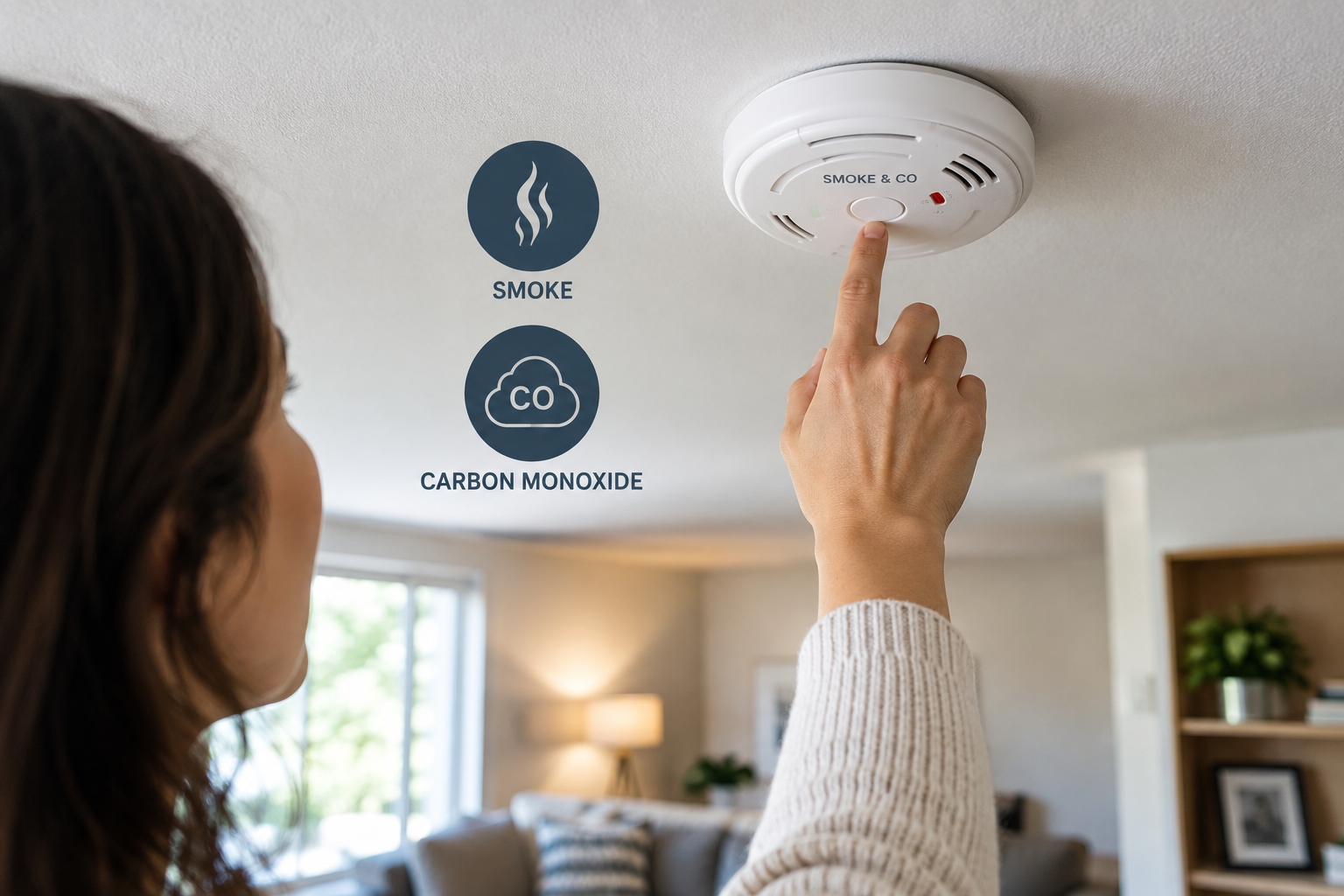
Smoke alarms and CO alarms can be installed as stand alone units, or as combination units that can detect both smoke and CO.
Before a new tenant moves into a unit, the landlord or property owner should make sure that their installed alarms comply with the applicable requirements and manufacturer’s instructions.
Landlord Responsibilities
Under California Health and Safety Code § 13113.7, the owner of a rental property or the landlord managing it has important responsibilities for ensuring that the required smoke and CO alarms are installed, operable, and properly maintained.
California law places the responsibility for maintaining the required alarms on the property on the property owner, while the tenant has a responsibility to notify their landlord or property owner when an alarm becomes inoperable.
For property owners and managers, the safest approach is to treat smoke and carbon monoxide alarms as part of an ongoing maintenance responsibility, and not simply a one-time installation.
Documenting the process can help ensure that alarms are checked and maintained regularly, and that tenants know how to report a problem.
To ensure that their units stay compliant with the law, property owners and landlords should take steps to ensure these alarms are functional when the tenant takes possession.
- Follow the legal requirements for the number of alarms that should be installed in a given home, as well as where and how.
- Retain the instruction manuals for smoke and CO alarms. Follow their recommendations for life expectancy, testing, and alert meanings.
- Document the installation date, maintenance records, and even keep dated photographs. These can be invaluable should a situation involving litigation arise.
- Provide information packets to your tenants regarding the features and functions of smoke and CO alarms.
- Ensure periodic maintenance and upkeep of smoke and CO alarms to keep them in working order.
- Include information regarding battery maintenance and how to handle nuisance alarms.
- Be sure to include instructions on adequately reacting to an alarm, including the difference between a smoke alarm and a CO alarm signal.
- Instruct tenants to contact the fire department immediately after exiting the unit.
Documenting your efforts to keep these critical alarms functioning is particularly important for property owners and landlords. Keeping accurate documentation ensures that there is a record of safety devices being installed, maintained, and repaired when necessary. In the event of an incident or litigation, these records can demonstrate that your standard of care was met.
By following a consistent maintenance and documentation process, landlords can help protect their tenants, while reducing the risk that a preventable alarm issue causes an incident or creates liability.
Tenant Responsibilities
Although landlords and property managers maintain the bulk of the responsibility for the required smoke and CO alarms, tenants also have a role in keeping these devices working.
California law requires that tenants notify their landlord or property manager as soon as possible when they discover that an alarm is no longer in proper working condition, so that it can be fixed or replaced.
Tenants should also follow the manufacturer’s instructions, and promptly notify their landlord if an alarm is chirping, malfunctioning, or requires other maintenance. It’s also good practice for tenants to dust or vacuum their smoke and CO alarms at least once per year.
In addition, tenants should also be sure not to remove, paint over, or unnecessarily tamper or obstruct the alarm units.
Sometimes tenants experience “nuisance alarms”, those that trigger without obvious reason. However, an alarm that repeatedly triggers without an obvious cause may be malfunctioning, but it can also possibly indicate another problem with the property that needs investigation. Contacting your local gas and electric utility such as PG&E can send a trained expert to determine if there is a problem with the alarm unit, or if there is a more serious issue like a bad furnace.
Tenants should never remove a battery or disable an alarm because it is inconvenient or produces a nuisance alert. Always contact your landlord or property manager so that the issue can be properly investigated and addressed.
In the event of a legitimate alarm, tenants should do their best to keep calm and follow the appropriate emergency procedures. Leave the property and contact emergency services when appropriate. Once you are safe, contact your landlord and let them know about the incident.
Tenants, landlords, and property managers working together to keep smoke and carbon monoxide alarms working properly keeps everyone safe and helps avoid serious hazards.
Need Help with Your Property? Contact Edrington & Associates
Edrington and Associates specializes in solving real estate challenges in California. We provide real estate brokerage services, litigation consulting, and expert witness testimony, including property owner/ manager standard of care, habitability, rent differential analysis, and HOA and Broker/Agent standard of care. We also provide consulting services for rent increases and condo conversions.
Contact Edrington & Associates to learn more about our real estate consulting and expert witness services